
Three-Shifting your way to Decent Estate
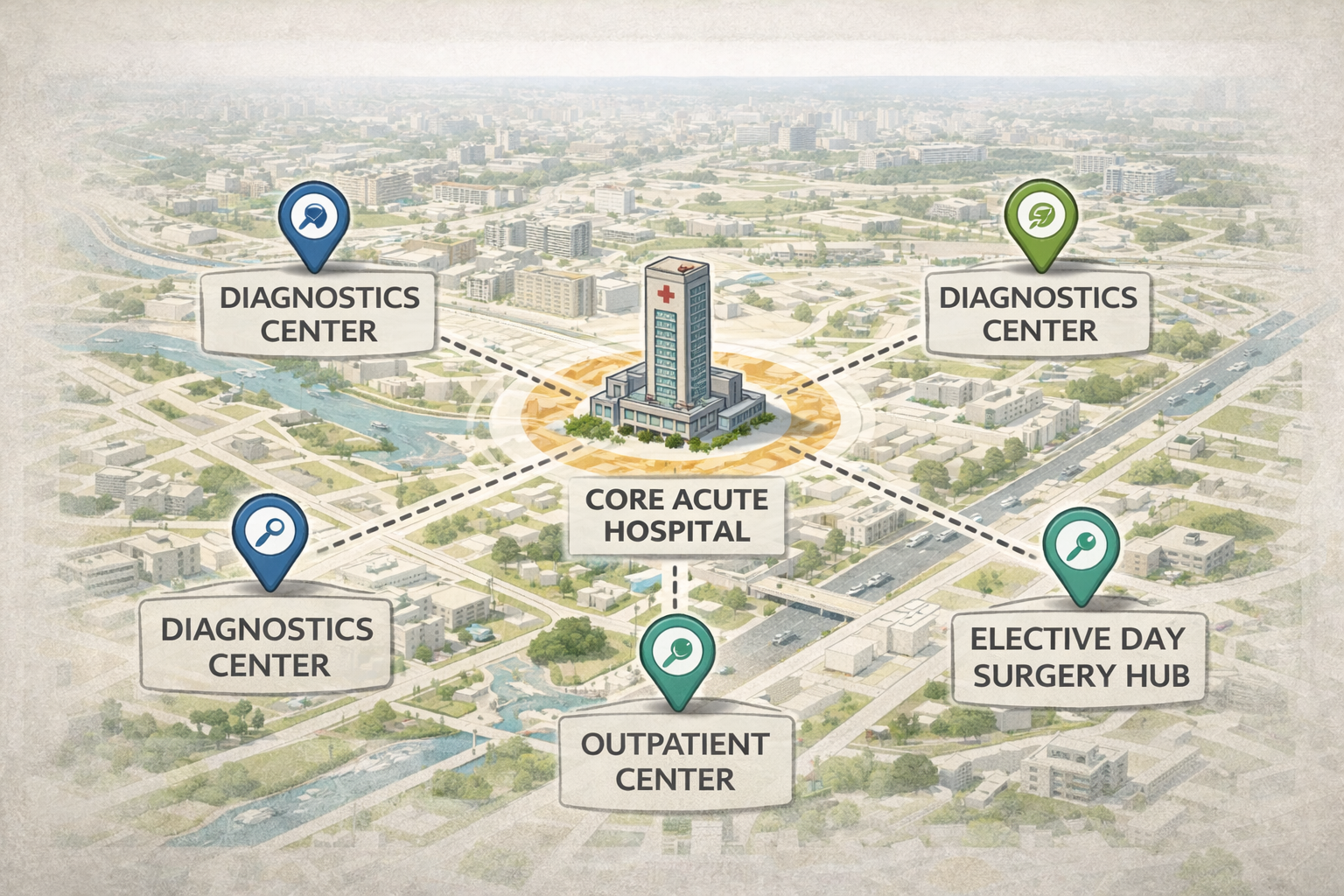
The traditional acute estate sits together on one coherent site. Everything goes there. It attracts so many people that local traffic management and parking becomes an issue. It’s a vast employment generator. It creates economic activity and then contains this on site in the form of hospital shops and cafes.
What if we could limit this core hospital function to only what absolutely has to be there, releasing the rest of the land for housing or life sciences? What if most of its activity happened on high streets and the economic impact was distributed? And what if existing hospitals could start transitioning to that now and deliver the three shifts at the same time?
The thinking from this article is featured in Fortis Magazine, here
I wouldn’t wish an NHS CEO job on my worst enemy. You’re responsible for everything, but you need approvals for anything. You have an absurd challenge to continue to do more with less – and your estate is probably falling apart. Meanwhile, you are being badgered about the three shifts with no funding to back it up. But the good part of the job is that you can leave a legacy. What if you were able to fix the estate, while delivering the three shifts, improving access and making your community that bit more healthy? This article is meant to provoke you into shaping your own practical route for sharpening the purpose of your hospital and funding it in a way that is both affordable and politically saleable.
You’re in charge, and you’re not getting a rebuild
You’ve got a Trust with a lot of failing estate. We’ll call it Condition C and D, since we love the NHS Estates Code. Maybe you have a spot of RAAC. No doubt ventilation is terrible. Your maintenance backlog dwarfs your likely capital allocation. There’s no credible route to a full new build in the near term:
The New Hospital Programme (NHP) is badly delayed and over-subscribed.
The capital budget is improved but remains tight, and anyway requires a procurement which will take years so you keep buying doors and machines in the last two months of the year.
PPP is not yet landed in practice.
You are not getting a shiny new hospital that solves this in one go. So what do you actually do?
Wes Streeting’s three shifts
We all know them. Hospital to community. Analogue to digital. Sickness to prevention.
And then there’s this new Neighbourhood Health Service, not to mention the Health on the High-Street we all used to be so keen on – and who remembers Anchor Institution?
Apparently Barnsley knows how to do. Perhaps after sorting the elective backlog, A&E waits, maternity safety and the underlying deficit, it might be worth giving them a call.
The Idea
The idea here is to plot a path to:
A smaller, sharper core hospital, focused on what absolutely has to be done on that site.
Most, if not all, elective, outpatient and corporate activity delivered in community and high-street spaces – but still by the acute Trust, not dumped on primary care.
A digital and logistics “operating system” that makes the dispersed model work.
Tangible community benefits that reduce your costs: Better access for all patients, including hard-to-reach groups; a stronger high street economy (with all the health benefits that brings); a platform for changing working practices (shared offices, community partnerships).
Get your CFO onto it
Burrum Partner, Rhiannon Williams, has written a handy guide for CFOs to help them get ready for new community PPP – but it also covers some of the basics you’ll need to get right: asset registers, pipeline, transaction prep.
The How
This is all very nice language. Advisers are great at selling the sizzle – but where’s the steak? I’ve had a go at the steps here. Lots of people can help you deliver this, if you drive the idea.
Step 1 – Face the facts: a ruthless triage of the estate
How bad is it? And what’s good?
Personally, I’d get a full survey. I’ve seen these used to pretty good effect in PFI expiry and disputes. But it’s a really useful tool for estates management. It will give you a clear view of:
Excellent (Condition A).
Good (Condition B)
Average but tolerable. (Condition C)
Unacceptable (Condition D)
You might find shortcuts to this and that’s ok. A lot of this is part of the Estates Strategy work that NHS England is requiring anyway – so you might find you’re already doing it or you’ve done it.
Look for cheap “lift to A/B” opportunities
Identify estate that is B/C and below that:
Can be upgraded relatively cheaply to A or B.
Sit in the locations that might matter for a future anchor core (e.g. adjacent to key theatres or diagnostics).
This is about focusing on and aggregating what you can salvage for the new model, not patching everything.
What’s the point of doing this step?
I’m sure you already know your estate but the question is how well? And how do you communicate that to people who have the time to help you create a plan? You and your team have to start with a clear idea of what is structurally unsound, unsafe or uneconomic.
Step 2 – Sharpening the purpose of the hospital: designing the anchor core
Define what really has to be on the acute site
Which services absolutely have to be in the core hospital? One of my CEO friends that is known for being provocatively challenging thinks it could be only:
Emergency department and urgent care.
Intensive care and high-dependency.
High-acuity theatres and some day-case where adjacency really matters.
Maternity and neonatal.
Very urgent hot diagnostics (challenge what this is)
Any other service that absolutely relies on immediate access to ICU, theatres and emergency: things like high-acuity interventional radiology / cardiology.
This is about sharpening the purpose of the hospital, which is our most expensive estate. The hospital is for high-risk, high-acuity, time-critical work – not everything.
What moves out by design
Activities that should, by default, sit off the acute site:
Most, if not all, elective inpatient beds. Given that almost everything these days can be ambulatory, challenge yourself as to whether you need any.
Most, if not all, day-case elective surgery (where safe to separate).
Medically fit for discharge patients. Ideally into a new patient hotel in the community, perhaps into suitable on-site wards, run differently. The key thing is that these patients need a less hospital-like experience and their needs can be met with a lower cost model, with a building spec/fit out which is both cheaper and more suitable for them.
Outpatients
Corporate and back-office, training and non-clinical space.
This relies on reimagining the core functions. Outpatients becomes virtual-first: a “call centre plus clinics” model, with shared and bookable consulting rooms in community hubs and high-street facilities.
You will know better than me if this is safe, but if we want to make the kind of change that the 10-Year Plan envisages, we need to be ambitious about what could be possible and think less about barriers and more about new ways of doing things.
Benefits of a slimmed-down anchor core
The model I’ve described would no doubt present a lot of challenges and obstacles. But it’s not all downside.
Clinical and operational benefits:
Care is more resilient because it has fewer failing structures and plant to keep alive
Less avoidable disruption of electives by emergency surges: the electives factory approach.
Better infection control in from separation of lower-risk services and better estate.
Financial benefits:
Lower capital requirement for the core.
Lower backlog maintenance cost as more of the worst estate is removed from scope.
Strategic benefits:
An explicit response to the Three Shifts, Health on the High Street and the Anchor Institution agendas – all at once.
A clearer story for boards, regulators and ministers about what you are protecting and why.
Step 3 – Designing the Trust-run community and high-street platform
Describe the “neighbourhood health” footprint
This is about creating a place for the services which are displaced – but it’s also about building a coherent model for health hubs in town centres or local centres, near transport nodes and where people already go.
Functions to consider:
Outpatient clinics across multiple specialties.
Day-case and minor procedures.
Diagnostics (pathology and phlebotomy, CDC-style imaging, phlebotomy, some cardiology diagnostics).
Rehabilitation, therapy, mental health and wellbeing services.
Prevention programmes (obesity, smoking, alcohol, falls, etc).
The Acute Trust as a community participant
As an acute trust, you are probably the biggest employer in your community. You probably have a presence in every street – or almost. You should be playing your part in that community. So these hubs can be driven and operated by the acute Trust / provider collaborative, not only by PCNs. This could be about working with primary care, community services and VCSE as co-tenants, but it doesn’t need to be, certainly not as a first step, anyway.
They make for a sustainable shift from acute to community because they allow the Trust to:
Hold on to elective and outpatient revenue, to meet its existing cost base.
Meet access targets more credibly.
Meanwhile, bringing activity out of the hospital into the community means:
Repurposing empty retail/office space and helping to stabilise town centres and support local regeneration. Maybe the Council will even give you some support!
Increased footfall and co-located services support healthier lifestyles and better social determinants.
More convenient access, especially for people in work, carers, and marginalised groups.
A stronger narrative for local government and Treasury: health capital is also regeneration capital.
Step 4: Map it out, affordably and safely
At this point, you know what you’ve got and you know what you want. But you don’t have the budget to do it all now. So, you need a multi-year plan to move as fast as you can afford. There are two parts to this planning: Estates and Digital.
Estates Mapping: Making the move from Hospital to Community happen
I’d suggest some key elements to think about in making this plan:
Use off-balance sheet finance when you can. Rhiannon talks about much of this in more depth in her article and I cover it a bit more below.
Look at what can be done quickly and cheaply. Bringing existing buildings from C to B, if you can. Some services will be able to be moved into office or shop-style accommodation, probably already vacant on the high street.
How can you package the work into affordable capital chunks? Have packages ready to go for the kind of capital that can become available later in the financial year: £20m and £50m packages, preferably already procured, so you can act fast. Consider getting a pre-procured delivery partner, so that some of that money for doors and machines-that-go-bing can be diverted into tangible investments in the new estate.
Use this information to create a multi-year, costed and funded, dynamic capital plan that should be driven conscientiously. This should include procurement plans and funding plans. Those funding plans should be in your budgeting – and you should have procured projects on reserve to step into any gaps created by delays to delivery. When one project is held back or delayed, there should be another ready to go, so no capital is lost.
Include your maintenance and lifecycle plans: Too often the day-to-day carries on in spite of the strategic. Too often, buildings are slated for major repairs and refurbs immediately before they are then decommissioned. Who hasn’t seen three separate utilities companies dig up the same road in the same month, just after the Council has comes in to fix the pot holes? Co-ordination is everything.
Look out for funding pots that can accelerate your progress: System underspends, new neighbourhood funding, diagnostics pots, carbon reduction funds. All of it can help.
This can’t be done by an estates team or estates advisers on their own. Clinical and operational teams need to contribute to how it could work. Finance colleagues need to drive funding, budgeting and costing plans. If you have a good procurement person, get them to look at the sort of models used for LIFT and Building Schools for the Future. Look at what’s possible under framework agreements to pre-procure parts of the plan or get an embedded construction/funding parter in place, who can act fast when funds flow.
Digital Plan aka Analogue to digital: the operating system for dispersed care
None of this will work without a strong plan for digital and logistics.
Why were hospitals built big in the first place?
In short, the old model put everything in one place because:
Clinicians needed to talk to each other.
Patients, staff, kit and specimens needed to move quickly.
So, if you break that up, you’ve got to deliberately rebuild that glue. Fortunately, we have digital and logistics capabilities now that we couldn’t have dreamed of then – and they are going to be key, if this isn’t going to be a disaster.
The digital spine
Honestly, my advice here is to talk to someone smarter than me about this. But you will need a solution and I don’t think it will work without one. This is about connecting records, electronic ordering, virtual consultation, complex rostering (across multiple sites). It’s also about connecting people: Finding ways to make sure that valuable consults will happen, without the shared canteen as an enabler. This is stuff that has been solved in other industries and it can be solved in the NHS too.
The logistics layer
Again, this is about making communication between sites work - not just of messages but of people and things. We’ve seen logistics undergo a revolution with businesses like Amazon. There’s much more available than before. But also, think about how people move. Some Trusts are working with Councils to put in place better transport routes and fund free travel for staff, for example. There’s going to be a way – but you need to be ambitious and get clever people onto it.
What will this give you?
A deliverable, costed, funded plan to fix the estate
A deliverable plan to move from hospital to community
A more digitally enabled service which remains connected
More access to finance because you have less reliance on CDEL.
Step 5 Managing transition and double-running
Ther will be some, probably. Just as there is when a whole new hospital is delivered. When the Midland Met was complete, Sandwell and West Birmingham NHSFT needed to sell off City Hospital. Maybe you can avoid double-running – but you won’t avoid some dead spaces, at least for a while. But you’re doing this to deliver an end-state footprint which is smaller, more suited to modern medicine and better for patients, staff and the community. Focus on decommissioning and selling the vacated estate, as quick as you can.
Phase 1 – Stop-loss:
Freeze non-safety investment in “dead” buildings identified in triage.
Make only essential safety fixes. Don’t do what we’ve all seen so often and totally renovate a building which is being closed in a year. This is why your maintenance / lifecycle plan has to be part of your estates strategy.
Phase 2 – First high-street / community hubs:
Move a meaningful chunk of outpatients and diagnostics into one or two flagship sites.
Prove impact on access, DNAs, staff satisfaction.
Phase 3 – Consolidation:
Use the new hubs to support closure and disposal of the worst hospital blocks.
Reinvest savings and receipts into the anchor core and further hubs.
So you fund what with what?
My background is projects, funding and PPP, so I can’t just say “use off-balance sheet when you can”, can I?
There’s no point me specifying a capital strategy that will work for everyone, but my sense is that the following broad principles will help:
Fund the anchor core with CDEL, generally speaking. Partly because PPP is supposed to be limited to “community”. You may find use cases for pay-per-use models. You’ll certainly find things like car parks, retail and PPUs that can be funded privately. See What do you do if you don’t have capital? But generally speaking, use your CDEL to fix and consolidate the best-located A/B buildings into the anchor core. And to build or refurbish selected elements where there is no alternative. The point here is this: Because the scope is smaller, the CDEL ask is smaller and more defensible. Maybe you’ll even get central funding to prove the case.
Use off-balance sheet for community and high-street estate. PPP will be an option. Also look at short and medium-term leases of existing or refurb property. These options usually have a reduced CDEL ask over new builds and often provide better value and quicker delivery.
See if you can get the technology and logistics off balance sheet. Where possible, procure as services rather than capital assets, to limit CDEL impact.
You’ll probably have a fab CFO that you can pass this section onto, who, after muttering unrepeatable curses about IFRS16, will give this a good go.
Shrinking the more expensive anchor core, and taking advantage of reduced-CDEL models for community, should deliver a much lower total capital envelope than a full rebuild of “everything, everywhere”. And because you are looking at a long-term programme, you aren’t looking for every last pound of the system capital envelope tomorrow. And that programmatic aspect means you can hoover up available capital when it appears and you’ll be progressively freeing up space at the anchor core which maybe you can sell – perhaps for housing, another government and community priority.
Don’t wait for the perfect clinical strategy
For years, I added my voice to the many who said that you do the clinical strategy first and the estates strategy should follow it. It’s an enticing message: “get the clinical strategy right, then design the estate to fit”.
The problem with that is that the clinical strategy will be out of date next Thursday, maybe Friday. The pace of change is too fast.
Let’s think about cardiology as case study. Cardiology is a good example of why you can’t design a 50-year estate around a frozen view of clinical practice. Over the last 15–20 years cardiology has shifted decisively from open surgery to minimally invasive and interventional approaches, backed by far more powerful drugs and devices. Surgery and inpatient stays are dramatically reduced from the 1990s. Clinical practice keeps moving as techniques change, devices improve and risk profiles fall. What looks “core” today may be routine day-case tomorrow.
The emerging science underlines the point. Glenn King’s team at the University of Queensland in Australia is developing a protein from the K’gari or Fraser Island funnel-web spider, known as Hi1a. Early studies suggest it can protect heart and brain tissue during a heart attack or stroke by stopping the cascading cell death that follows a period of lost blood flow. King talks about the possibility of a pill that paramedics could give at the scene. The idea is simple: stabilise the tissue first, then deal with the clot or damage once the immediate crisis has passed. Whether or not Hi1a becomes a clinical product, it shows how quickly the fundamentals of a pathway can change.
A 50-year estates plan that can keep up with this kind of change is fantasy. Your objective is to create flexible spaces which will work for whatever we happen to be doing in them in 30, 40, 50 years. And this is where moving to the high street can help. If you’re in a shopping centre and the space isn’t right, there will be another that probably is. Or you can move out. It’s miles more flexible than an acute hospital site. Our principles for the estate planning can be as simple as:
Virtual-first, community-first, where safe.
Highest-acuity work in the anchor core.
Adaptable space everywhere else.
What we aren’t doing here
We are not hollowing out the hospital or its budgets. Revenue stays with the Trust. Costs are not therefore stranded by the model in the way that they could be by a recommissioning decision.
This is not about dumping work on primary care. Primary care is a partner, not a dumping ground and we are asking no more of them.
We are not hollowing out or competing with existing community providers. Nothing about this needs the acute to do anything new. Just in a different place. I hope that this will lead to better models of care, but I don’t think a lot of acutes are looking for more work.
We are not reviving PFI. We are doing the shiny new PPP model which just looks awfully like it. PPP is a tool, not the strategy. And frankly, it delivered over 100 new hospitals. We have been circling around ourselves for six years trying to deliver 40. I’ll happily take PFI if you give it to me. And if you really want to know what I’d do to improve PFI, have a look at What could a new PFI look like?. It’s a touch dated but the concepts are broadly there.
What you could do if you follow this path
If you follow this through, you are not just coping with a failing estate. You are delivering exactly what Wes keeps asking for. On hospital to community, you end up with a smaller, higher-quality anchor hospital that does the things only a hospital can do, and a network of Trust-run hubs and high-street facilities that handle a big chunk of outpatient, diagnostic and elective work. For patients, that means care closer to home, lower DNAs, and fewer unnecessary trips through the front door of the acute site. For you, it means you stop trying to run every kind of care through the most expensive, least flexible buildings on your books.
On analogue to digital, you are forced to build a proper operating model for a dispersed service: one version of the record across sites, one way of doing virtual consultations, one approach to scheduling and logistics. It is much easier to justify serious investment in digital when it underpins a visibly different way of working, rather than yet another skin on the same old hospital. This gives you a credible path to the “digitally enabled” service that keeps appearing in policy documents.
On sickness to prevention, the estate starts doing some of the work for you. High-street and neighbourhood hubs are places where you can bolt prevention and early intervention onto everyday life: screening, lifestyle support, falls clinics, smoking cessation, mental health, social prescribing. You are putting health services into places people already use, alongside councils, employers and voluntary groups, instead of asking them to come to an out-of-town acute site for everything. You are becoming more a part of the community and you are contributing more meaningfully to the local economy, with the health benefits that an improved economy brings to its residents. That does not magically flatten demand, but it does give you a platform that makes prevention part of normal operations rather than a grant-funded side project.
Different groups get different upsides. Patients see shorter and more reliable waits for planned care, more appointments they can get to without taking a day off work, and less time spent in big general hospitals when they do not need to be there. Staff get an acute site that is less chaotic and physically falling apart, new roles in hubs that offer more predictable patterns and less trudging around an ageing footprint, not to mention better transport options to high-street locations. Boards and regulators see a lower capital requirement for the acute site, a clearer pipeline for disposing of poor-quality estate, and a more flexible cost base in the community estate instead of being locked into one giant bet. Local economies get vacant space brought back into use, more footfall and jobs in town centres, and a visible sign that the Trust is acting like the anchor institution everyone talks about. National policy-makers get something they have struggled to secure: a concrete example of all three shifts – hospital to community, analogue to digital, sickness to prevention – being delivered in one coherent plan, rather than in three unconnected workstreams.
Conclusion: a realistic renewal, not a fantasy rebuild
I am certain that there will be holes in this and that some of it is probably wildly unrealistic. But I’m equally certain that clever people can probably make a version of this work, even outside Barnsley. None of this gives you a free pass on the day job. You still have the elective backlog, the four-hour standard, maternity safety, staffing gaps and the deficit to deal with.
The choice is between:
continuing to patch up everything you have, or
accepting that you cannot fix it all now, so you deliberately reshape what the hospital is for and where everything else should sit, backed by a costed and funded plan for delivery.
If you take up this challenge, maybe you’re going to find a way to reshape your hospital, build a Trust-run community and high-street platform around it, and use digital, logistics and new capital routes to make the whole thing hang together.
So the question for CEOs is not “How do I fix every building?” – because you can’t. The real questions are: “What is this hospital for, what can safely move out, and how do I move it in a way that delivers the three shifts and leaves us better off?” If you do that, you have a chance of turning an impossible brief into something that feels like a legacy, rather than a holding operation.